


Best Compact Bike Ratchet Set for Real Repairs
A loose stem bolt halfway through a wet club ride is when the best compact bike ratchet set earns its place in your pocket or saddlebag. A basic multi-tool may get you moving, but a small ratchet gives you better access, more leverage and far greater control when a repair cannot wait until you are back home.
The right kit is not simply the one with the most bits. It needs to match the fasteners on your bike, fit into confined spaces around bottle cages and cockpits, and stay compact enough that you will actually carry it. For road, gravel, mountain bike and commuting riders, that balance is what turns a tool kit into reliable ride-ready equipment.
What Makes the Best Compact Bike Ratchet Set?
A compact ratchet set should solve common bike jobs without feeling like workshop hardware stuffed into a case. Its main advantage over an all-in-one multi-tool is the ratchet head: it lets you turn bolts through short, controlled movements where a full Allen key swing is impossible. That matters around rear shocks, mudguard mounts, saddle rails, brake callipers and tight cockpit hardware.
Start with the ratchet mechanism itself. Look for a positive directional selector and a fine engagement feel. A ratchet that needs a large sweep before it catches can be frustrating in close quarters. A smaller head is usually better for bicycles too, provided the construction is strong enough for normal maintenance work. Professional-grade steel internals and a secure bit holder make more difference than a flashy oversized handle.
The handle must also offer enough grip. Ultra-light tools can feel excellent in a jersey pocket, but a very short or smooth handle limits the torque you can apply. That is acceptable for emergency adjustments, yet less useful for regular home servicing. The best option depends on whether your priority is minimal carried weight or a more capable tool for both the garage and the road.
The bits you will genuinely use
Most modern bikes rely heavily on hex bolts, so 3mm, 4mm, 5mm and 6mm hex bits are the core of any useful set. A 2mm bit can be handy for smaller accessories and certain control components, while an 8mm bit has a place on some pedals, crank bolts and axle systems. Torx bits are increasingly relevant, particularly T25 for disc brake rotor bolts and some cockpit hardware.
A sensible compact kit does not need every bit size imaginable. It does need the right ones, securely held in a case or bit carrier so they do not disappear at the bottom of a bag. Before buying, check your own bicycle. A road bike with electronic shifting, disc brakes and a modern stem may need a different selection from an older hardtail with mechanical rim brakes.
A short extension is one of the most useful additions. It improves reach and lets the ratchet clear awkward angles, especially when working around a frame tube or deep bottle cage bolt. On the other hand, carrying several extensions and adaptors can undermine the point of a compact system. One well-made extension is normally enough.
Ratchet Set Versus a Standard Bike Multi-Tool
A multi-tool remains a smart choice for riders who want the smallest possible emergency backup. It is simple, often lighter, and can cover basic adjustments to saddle height, lever position and loose bolts. For a quick pre-ride check or a commuter who has little storage space, it may be all that is needed.
A compact ratchet set is the better choice when access and bolt control matter. The removable bits allow a lower profile than folding multi-tool arms, helping you reach bolts that sit close to frames or components. The ratchet action is more efficient during repeated turns, and a longer handle can make a stubborn bolt manageable without resorting to improvised leverage.
There is a trade-off. A ratchet kit has separate pieces, which means a loose bit can be misplaced if the storage system is poor. It may also weigh more than a tiny folding tool. Riders who never adjust their own bikes may find it excessive, while cyclists who regularly fit accessories, maintain their cockpit or travel with their bike will appreciate its flexibility immediately.
Compact Does Not Mean Suitable for Every Job
A ratchet set is excellent for controlled fastener work, but it is not a substitute for every workshop tool. Bottom brackets, cassette lockrings, crank extraction systems and high-torque pedals may require dedicated tools with longer handles. Forcing a pocket ratchet beyond its intended load risks damaging the mechanism, rounding a bit or overtightening an expensive component.
Torque is the key consideration for carbon components. A compact ratchet can turn a stem faceplate bolt, but it cannot tell you when you have reached the manufacturer’s specified setting. If you own a carbon handlebar, seatpost or frame, pair your kit with a calibrated torque system for home use. A small torque adaptor can be a useful middle ground for travel, but it should cover the torque range your components require.
For roadside work, the ratchet is most valuable for tightening something that has worked loose, fitting a replacement part, adjusting a compatible accessory or making a careful emergency repair. It is not a licence to tighten every bolt as hard as possible. If a bolt repeatedly loosens, inspect the threads, component condition and specified torque before the next ride.
Build a Ride-Ready Repair System Around It
A ratchet set becomes much more valuable when it is stored alongside the items needed to deal with the failures that actually stop rides. For tubed tyres, that usually means tyre levers, a puncture repair solution, a spare inner tube and a reliable inflator or mini pump. Tubeless riders may add a plug tool, plugs, sealant support and a valve-core tool.
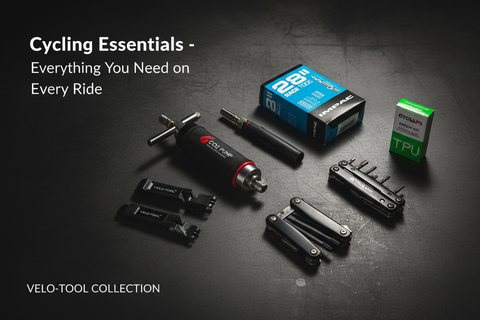
Keep the package deliberate rather than oversized. A road rider can often fit a compact ratchet, selected bits, a CO2 inflator, cartridge, tyre levers and TPU inner tube into a waterproof tool storage pouch. Gravel and MTB riders may need extra volume for a chain tool, quick link and tubeless repair equipment. The objective is not to carry a mobile workshop. It is to carry a system that gets you safely rolling again.
At home, the same ratchet set can cover frequent adjustments and accessory fitting. Keep it in a visible, dedicated location with a pump, chain checker, tyre equipment and cleaning supplies. When tools are organised, basic maintenance becomes a ten-minute job rather than something postponed until a minor issue becomes a missed ride.
Choosing the Right Size and Storage Format
A slim case is ideal for jersey pockets, but check that it closes securely and does not rattle. Waterproof or water-resistant storage is worthwhile in British conditions, particularly when the kit lives under a saddle or in a frame bag through winter. CNC aluminium cases can offer excellent protection with very little bulk, though fabric pouches may conform more easily inside a tightly packed bag.
For riders choosing one set to use everywhere, a compact ratchet with core hex bits, T25, an extension and secure storage is the strongest starting point. Add a torque solution if you work on carbon parts, and select the remaining repair equipment according to your tyre setup and riding distance. Velo-Tool’s approach to complete, practical kits is useful here: choose equipment around the repair scenario, not a random pile of gadgets.
Before your next long ride, use the kit at home on your own bike. You will learn which bits fit, whether the extension reaches the awkward bolts, and where each item packs best. That small rehearsal is often the difference between a calm five-minute roadside fix and standing in the rain wishing you had brought the tool you bought.


Inserisci commento